
In today’s fast-paced, ever-evolving world, upskilling has become the key to staying competitive. As industries and technologies advance, employees need to adapt quickly to new tools, systems, and strategies. This is where platforms like Coursera for Business come in, offering companies an easy way to equip their workforce with the skills they need to thrive in 2026 and beyond.
But here’s the real question:
Is Coursera for Business the right fit for your company’s upskilling needs? 🤔
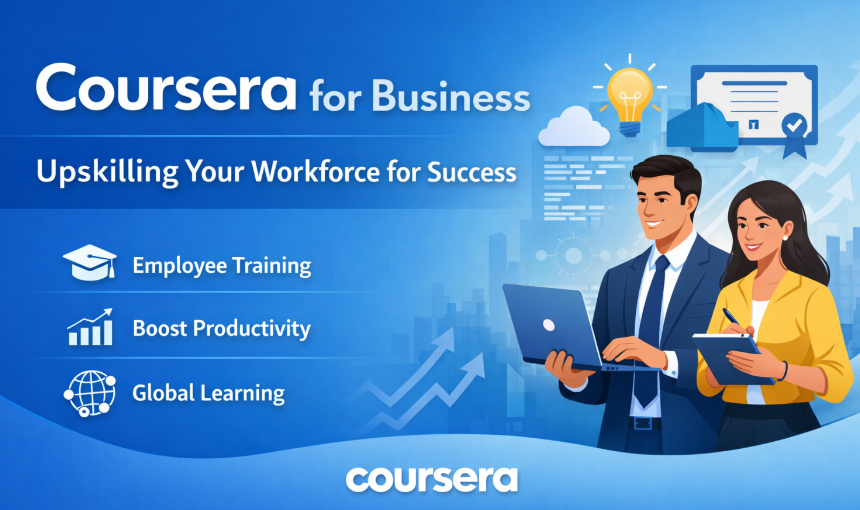
With thousands of courses, certifications, and partnerships with top universities and organizations, Coursera offers a structured, flexible learning environment designed to meet the needs of modern businesses. Whether you’re in tech, finance, or even healthcare, Coursera for Business can help upskill your employees in ways that drive real, measurable results.
But, is it the best choice? How does it compare to other training programs?
In this article, we’ll dive into how companies are using Coursera to upskill their workforce, explore the key benefits it offers, and guide you on how to get started with this powerful platform.
By the end of this, you’ll know exactly why Coursera for Business might be the game-changer your organization needs. 🚀
📌 Why Upskilling Matters for Companies in 2026? 🌍💼
In 2026, upskilling is no longer optional it’s essential. As industries evolve and new technologies emerge, businesses must ensure their employees stay relevant and competitive.
Why Is Upskilling Crucial?

- Adapting to Technology 🚀
With rapid advancements in AI, automation, and machine learning, employees need to stay ahead by acquiring future-proof skills. - Bridging the Skills Gap 📊
Businesses face a growing skills gap. Upskilling helps fill that gap, especially in fields like data science, cloud computing, and digital marketing. - Boosting Retention 💡
Employees value companies that invest in their growth. Upgrading skills improves job satisfaction and reduces turnover. - Staying Competitive 🌍
To thrive in a competitive market, companies must keep their workforce skilled and adaptive to changes in the industry. - Supporting Remote Work 💻
As remote work grows, platforms like Coursera for Business allow businesses to offer upskilling globally, keeping all teams aligned.
📌 What is Coursera for Business? 🎓💻
Coursera for Business is a corporate learning platform designed to help organizations upskill their employees in a flexible, scalable, and cost-effective way. Unlike the regular Coursera platform, which is primarily aimed at individual learners, Coursera for Business offers enterprise-level solutions that can be customized to meet the specific needs of a company.
Key Features of Coursera for Business:
- Custom Learning Paths:
Companies can design personalized learning paths tailored to their teams’ skills and business goals. Whether you’re training tech teams in cloud computing or HR teams in leadership development, Coursera has relevant, high-quality courses. - Employee Development at Scale:
Coursera for Business makes it easy for large teams or entire organizations to access professional courses from top universities and global industry leaders like Google, IBM, Meta, and more. This scalability makes it suitable for businesses of all sizes. - Tracking and Reporting:
Managers have access to data-driven insights that show how employees are progressing, which courses they are taking, and how these skills are being applied in real-world work scenarios. This allows businesses to measure the impact of their training programs. - University-Backed Certificates:
Employees can earn certificates from top universities (like Stanford, University of Michigan, and Yale) that add significant value to their professional profiles. These recognized credentials can help improve retention rates, enhance skillsets, and increase employee motivation.
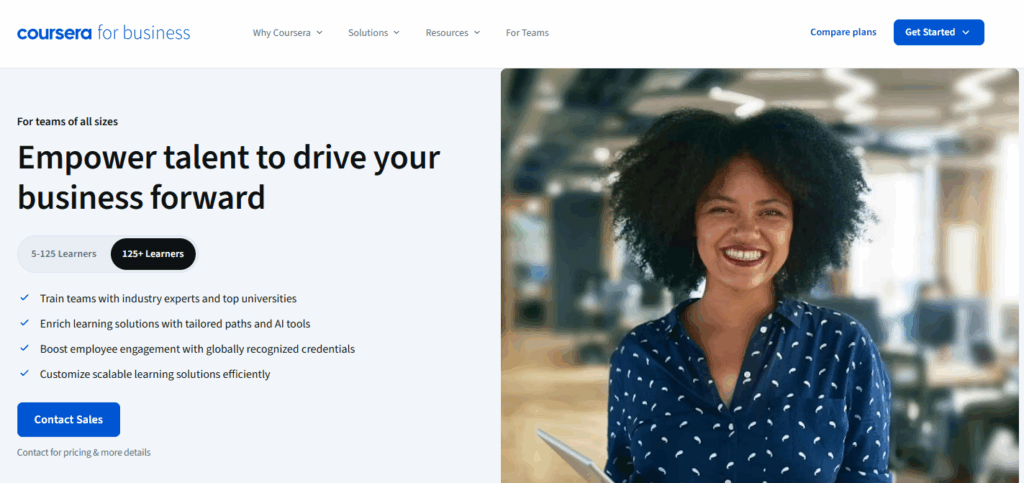
Why Companies Choose Coursera for Business:
- Global Reach: With courses in over 50 languages, Coursera for Business is accessible to organizations globally, making it ideal for multinational companies.
- Flexible Learning: Employees can learn at their own pace, on their own schedule, from anywhere, making it easier for businesses to offer continuous learning without disrupting daily operations.
- Cutting-Edge Content: Coursera partners with leading universities and organizations to provide industry-relevant courses on emerging topics like AI, blockchain, data science, and digital marketing.
📌 Why Do Companies Choose Coursera for Business? 💡📈
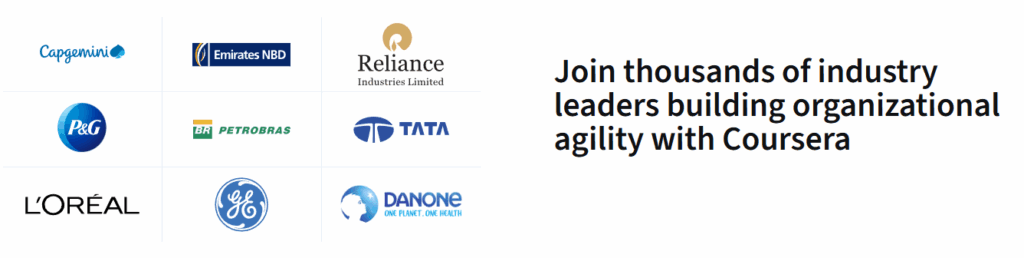
Companies choose Coursera for Business because it provides a comprehensive, scalable solution to meet their upskilling needs, combining flexibility, quality, and measurable results. Here’s why it’s becoming a top choice for global enterprises:
1. Global Reach 🌍
- Coursera’s partnerships with top universities and industry leaders ensure that employees across different regions can access the same high-quality learning resources.
- The platform supports over 50 languages, making it ideal for multinational companies with diverse teams.
2. Scalability 📈
- Whether you’re training 10 employees or 10,000, Coursera for Business easily scales to your needs. It allows global teams to learn at their own pace, all while staying aligned with company goals.
- It’s designed for businesses of all sizes from startups to large corporations.
3. Customization and Flexibility 🔧
- Companies can customize learning paths based on employee roles and career development plans.
- Flexible learning schedules allow employees to balance their professional duties with their learning, ensuring that upskilling is part of their regular routine without overwhelming them.
4. Data-Driven Insights 📊
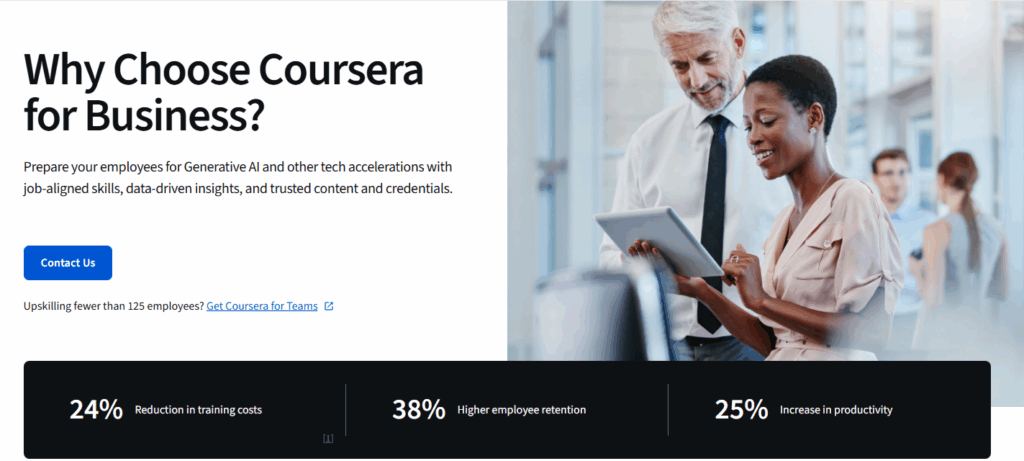
- Coursera for Business provides advanced analytics and progress reports that help businesses measure the effectiveness of their training programs.
- HR and learning managers can track how employees are progressing, which skills are improving, and what areas need more attention.
5. High-Quality, Trusted Content 🎓
- Coursera works with prestigious universities and industry giants (like Google, IBM, and Meta) to ensure that the content employees access is relevant, up-to-date, and industry-recognized.
- With a focus on real-world applications, Coursera’s content ensures employees are gaining skills that employers value.
6. Cost-Effective Training 💸
- Compared to traditional in-person training and seminars, Coursera for Business offers a more affordable solution for businesses looking to invest in employee development.
- Subscription-based pricing means companies can offer unlimited learning for their employees at a fraction of the cost.
“Many companies, like those listed on PowerToFly, are prioritizing upskilling programs to ensure their workforce remains competitive and adaptive to changing technologies.”
📌 How Do Companies Use Coursera for Employee Upskilling? 🛠️👩💻
Coursera for Business empowers companies to deploy hyper-targeted upskilling programs, turning skill gaps into strengths.
With AI-driven recommendations and admin tools, HR builds custom paths that tie directly to KPIs. Let’s break down real-world applications with deeper examples and metrics.
Technical Skills 🖥️
Focus: Hard tech competencies for digital transformation.
- Examples: AWS Certified Solutions Architect, Google Data Analytics Professional Certificate, or IBM’s Machine Learning Specialization.
- Impact: Accenture upskilled 50,000 devs, cutting deployment time by 40% and reducing cloud costs 25%. Indian firms like TCS use it for GenAI bootcamps, achieving 90% certification rates.
- Pro Tip: Integrate with GitHub for hands-on projects.
Leadership Development 👥
Focus: Building exec-ready talent from within.
- Examples: Yale’s “The Science of Well-Being” for resilience, Stanford’s “Organizational Analysis,” or INSEAD’s negotiation courses.
- Impact: PwC trained 20,000 managers, boosting internal promotions by 28% and leadership diversity by 15%. Reduces hiring costs saves $100K+ per exec role.
- Pro Tip: Pair with 360-feedback for personalized growth plans.
Industry-Specific Knowledge 📊
Focus: Sector-tailored expertise amid regulations and trends.
- Examples: FinTech compliance (CFA Society), healthcare HIPAA/GDPR (Johns Hopkins), or supply chain resilience (MIT).
- Impact: Citi rolled it out for 15,000 bankers, improving audit pass rates by 35%. In India, HDFC uses it for RBI fintech guidelines, ensuring 100% team compliance.
- Pro Tip: Leverage micro-credentials for quick wins.
Soft Skills Development 🤝
Focus: Human elements for collaboration in AI-driven workplaces.
- Examples: Meta’s “Leading Without Authority,” emotional intelligence from Google, or inclusive leadership from University of Pennsylvania.
- Impact: Boosts retention 32% (Gallup); L’Oréal saw 50% higher team satisfaction scores post-training. Vital for global teams spanning IST to PST.
- Pro Tip: Gamify with leaderboards for engagement.
By Q1 2026, 65% of Coursera Business users report direct revenue ties (Coursera metrics). Indian enterprises like Infosys and Wipro embed it in annual OKRs, syncing with tools like Zoho or Apollo.io for lead-gen teams. It’s not training it’s transformation. 🚀
📌 Key Benefits of Using Coursera for Business 💸🚀
Coursera for Business offers several compelling advantages for companies looking to invest in employee learning and development. From cost-effectiveness to employee engagement, here are the top benefits businesses gain by using the platform:
1️⃣ Cost-Effective Training 💰
- Traditional in-person training programs can be expensive and time-consuming.
- Coursera for Business offers a subscription-based model that allows companies to provide unlimited access to employees for a fraction of the cost of traditional training.
- Businesses can scale their training programs across multiple teams or even entire organizations without breaking the bank.
2️⃣ Global Reach and Flexibility 🌍
- With employees spread across different locations, global organizations can use Coursera for Business to ensure all team members have access to the same high-quality content.
- Courses are available in over 50 languages, and employees can learn at their own pace and on their own schedule. This flexibility helps businesses offer continuous learning without disrupting daily operations.
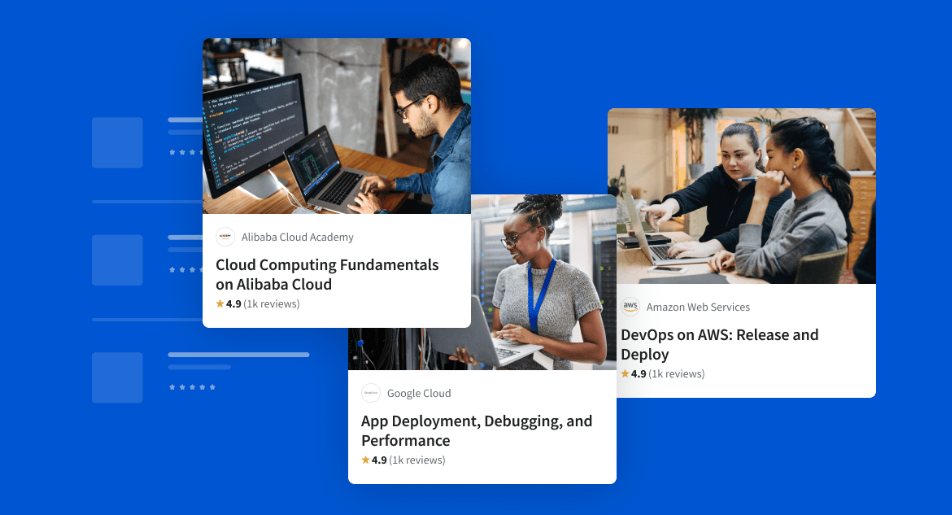
3️⃣ Customizable Learning Paths 🔧
- Coursera for Business allows companies to create custom learning paths for different teams or employee levels.
- Whether it’s technical training for engineers, leadership development for managers, or industry-specific knowledge for various departments, businesses can design learning experiences that align with their goals.
4️⃣ Measurable Results with Analytics 📊
- Coursera provides real-time insights and reporting tools to track employee progress, learning outcomes, and skills development.
- HR teams and managers can access detailed analytics to measure the impact of their upskilling programs and determine which skills are improving across the organization.
5️⃣ Employee Engagement & Retention 🌟
- Offering learning opportunities through Coursera for Business is a powerful tool for improving employee engagement.
- Employees who feel invested in through training and development are more likely to stay with the company, leading to higher retention rates.
- By providing access to industry-recognized certifications and professional development, businesses can keep their teams motivated and satisfied.
📌 Real-Life Success Stories: Companies Using Coursera for Business 🌟🏢
Many leading organizations have already realized the immense benefits of Coursera for Business in upskilling their employees. By providing access to high-quality, university-backed courses, these companies have successfully empowered their teams, boosting performance and driving innovation.
Let’s take a look at some real-life success stories:
1️⃣ Accenture: Empowering Employees in Data Science and Cloud Computing 💻
- Accenture, a global consulting firm, turned to Coursera for Business to upskill its employees in data science, cloud computing, and AI technologies.
- The platform allowed Accenture to provide scalable, flexible learning to thousands of employees across the globe.
- As a result, employees gained crucial technical skills, enhancing Accenture’s ability to serve clients in emerging tech sectors and ensuring the company stayed competitive in the digital transformation space.
2️⃣ PwC: Building Future Leaders with Leadership Development Programs 📈
- PwC (PricewaterhouseCoopers), one of the largest professional services firms, uses Coursera’s leadership and management development programs to train their employees on decision-making, strategic thinking, and leadership skills.
- PwC customizes learning paths based on role-specific needs, enabling future leaders to develop the skills needed for high-level management roles.
- Coursera’s platform allows PwC to measure employee progress and assess the impact of training on leadership capabilities, enhancing the firm’s ability to foster leadership talent from within.

3️⃣ Citi: Upskilling Employees in Financial Analysis and Business Strategy 💼
- Citi, one of the world’s largest financial institutions, uses Coursera for Business to help employees develop financial analysis, business strategy, and financial modeling skills.
- By offering relevant, certified courses from top universities like the University of Michigan and Wharton School of Business, Citi ensures its employees are well-prepared for complex financial challenges in a rapidly changing global economy.
- Coursera helps Citi’s workforce stay agile and well-versed in the latest financial practices, contributing to better decision-making and a stronger competitive position.
4️⃣ Salesforce: Fostering Innovation with Cloud Computing and Technology Courses 🖥️
- Salesforce, a global leader in cloud-based software, leverages Coursera to provide its teams with in-depth training in cloud computing, software development, and data analytics.
- Salesforce employees can earn certifications from top universities and industry leaders, enhancing their skills in emerging cloud technologies.
- This upskilling initiative empowers Salesforce to stay at the forefront of the cloud computing industry, enabling innovation and maintaining a competitive edge in a fast-moving tech landscape.
These success stories show how Coursera for Business is helping companies like Accenture, PwC, Citi, and Salesforce create highly skilled workforces that are ready to tackle modern business challenges. By using Coursera to upskill employees, organizations are able to stay ahead in their respective industries and foster talent development from within.
📌 How to Get Started with Coursera for Business 📝💡
Getting started with Coursera for Business is easy and straightforward. Here’s a step-by-step guide to help companies implement the platform for employee upskilling:
🔑 Step 1: Sign Up for Coursera for Business
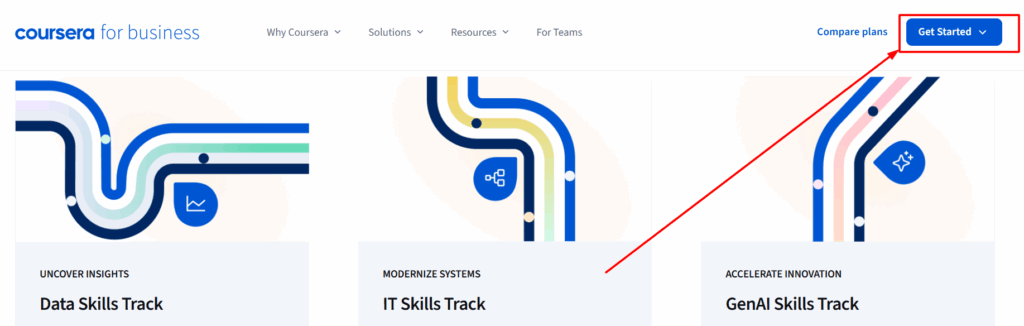
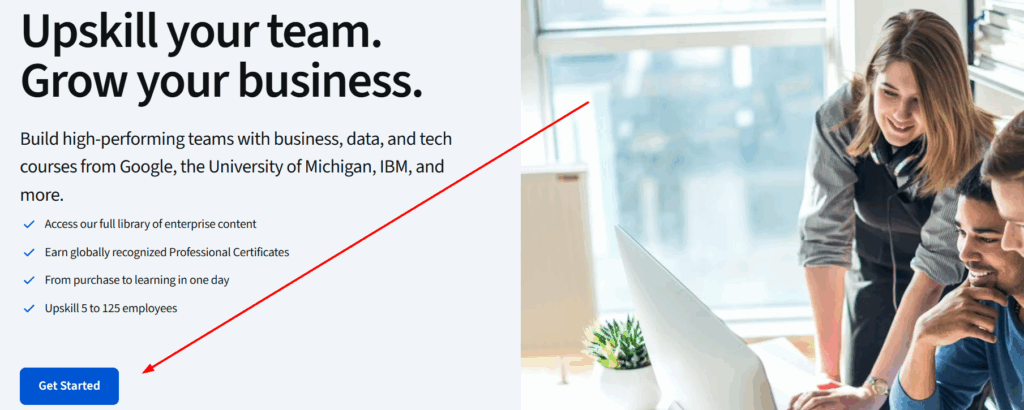
The first step is to sign up for Coursera for Business. Visit the Coursera website and explore the business solutions section. 📍 Once you’ve selected the plan that best fits your company’s needs, you can easily create an account to get started.
📊 Step 2: Set Up Your Team
Once you’ve signed up, you can create employee profiles and organize your team into different groups based on their roles, departments, or skill levels. 👥 Coursera for Business allows you to customize learning paths for different groups, ensuring that the training is relevant to each employee’s job function.
🧑🏫 Step 3: Choose Your Learning Programs
Browse through the wide range of available courses, certifications, and specializations in areas like leadership, technical skills, soft skills, and industry-specific knowledge. 📚 Select the programs that best align with your company’s upskilling goals.
You can also create custom learning paths and select specific courses based on your company’s unique needs. 🎯
📈 Step 4: Track Employee Progress
As employees begin their courses, use Coursera’s analytics tools to monitor progress, track completion rates, and identify any areas where additional training might be needed. 📊 With detailed reporting, you can measure the effectiveness of your training initiatives and adjust learning paths accordingly.
🎉 Step 5: Celebrate Success
Once employees complete their courses and earn certifications, celebrate their achievements! 🏆 Recognize their hard work through internal announcements, rewards, or promotions. By making learning a part of your company culture, you’ll inspire continuous growth and development.
8️⃣ The Future of Corporate Learning with Coursera 🔮📚
The future of corporate learning is rapidly evolving, and Coursera for Business is at the forefront of this transformation. As industries continue to evolve, upskilling will play a critical role in ensuring that companies can adapt to new technologies and business models. 🚀
🌟 Why Coursera for Business Is Essential for Long-Term Success
In the coming years, the demand for skilled employees will continue to grow, and the traditional methods of training may no longer be enough. Companies need to invest in scalable, flexible, and on-demand learning platforms like Coursera for Business to stay competitive in the global market. 🌏
As AI, automation, and remote work reshape the workforce, the need for continuous learning will become even more critical. Coursera for Business offers a solution that meets these needs by providing employees with the tools they need to innovate, adapt, and thrive in a constantly changing environment. 💡
Moreover, as data analytics and learning analytics become more sophisticated, companies will be able to tailor learning programs even more precisely to meet both individual and organizational needs. 📊
By investing in platforms like Coursera for Business, companies are not only upskilling their teams but also positioning themselves for long-term success. 🌱

Conclusion:
In today’s fast-paced, ever-evolving world, employee upskilling is essential for staying competitive. Coursera for Business offers a flexible, scalable, and cost-effective solution for companies to empower their workforce with the latest skills and knowledge.
With its customizable learning paths, real-world content, and global reach, it’s no wonder companies like Accenture, PwC, and Salesforce have successfully implemented Coursera’s training programs to enhance their workforce.
By investing in continuous learning through Coursera for Business, companies are not just training employees they’re building a future-ready workforce capable of thriving in a rapidly changing business landscape. 📚💡
“Read More”
- Coursera vs Udemy vs edX: Which Learning Platform Is Better?
- Coursera Certificates: Real Job Value Explained
FAQs ❓🌍
1️⃣ What is Coursera for Business?
Coursera for Business is a corporate learning platform that helps companies upskill employees through customized learning paths and certified courses from top universities.
2️⃣ How does Coursera for Business help companies?
It provides scalable, flexible training to improve employee skills in key areas like technical knowledge, leadership, and industry-specific expertise, driving business growth.
3️⃣ Can companies track employee progress with Coursera?
Yes! Coursera for Business offers analytics and reporting tools to track employee progress, course completion, and skill development.
4️⃣ Is Coursera for Business suitable for global teams?
Absolutely! Coursera offers courses in over 50 languages and is accessible globally, making it ideal for multinational companies with remote teams.
5️⃣ What types of courses are available on Coursera for Business?
Courses cover a wide range of topics, from technical skills (e.g., AI, data science) to soft skills (e.g., leadership, communication), industry-specific knowledge, and certifications.

Anas Khan is a digital marketing expert with over 5 years of experience in helping individuals and businesses grow through strategic online learning and coupon codes. He specializes in providing insider tips to maximize savings on learning platforms while guiding professionals toward career advancement. 🚀
With a passion for upskilling and growth, Anas shares valuable insights on how to leverage affordable learning opportunities to enhance skills and stay ahead in a competitive global market. 💡🌍