
Have you ever asked yourself, “Do Coursera certificates actually help in getting a job?” 🤔
You’re not alone. With rising education costs and fast-changing skill demands, many people are turning to Coursera for online certificates but the doubt remains.
Do recruiters really take these certificates seriously?
Are they just an extra line on your resume, or do they add real career value? 📄➡️🚀
Whether you’re planning a career switch, upgrading your skills, or trying to strengthen your resume, these questions are completely valid. In this article, we’ll focus on real-world value, not hype explained in simple, clear language.
👉 If you’re looking for honest answers, you’re in the right place.
🎓 What Are Coursera Certificates?
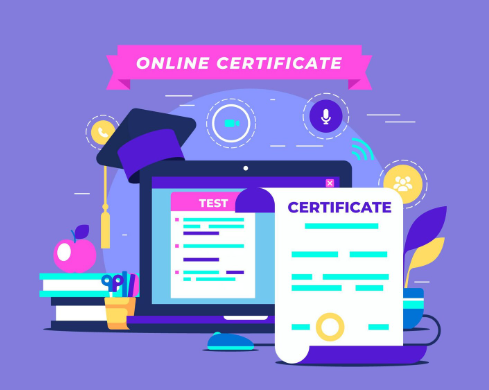
Coursera certificates are digital credentials you receive after successfully completing a course, Professional Certificate, specialization, or guided project on Coursera 📜. These certificates confirm that you didn’t just watch videos you completed lessons, quizzes, assignments, and in many cases, real-world projects.
What makes these certificates different from random online badges is who creates them. Many Coursera programs are designed with top universities and global companies (like tech firms and industry leaders). This means the course content usually follows industry-relevant skills, not just theory.
Another important point:
Coursera certificates are skill-focused, not degree-focused 🎯. They don’t replace a college degree, but they show:
- You can learn independently
- You’ve invested time in upgrading your skills
- You understand tools or concepts used in real jobs
Most certificates are shareable. You can:
- Add them to your resume
- Upload them to LinkedIn
- Share a verification link with recruiters 💼
From a hiring perspective, these certificates act as a supporting signal. Alone, they won’t get you hired but combined with projects, experience, or a strong portfolio, they can strengthen your profile and start conversations during interviews.
👉 Think of Coursera certificates as proof of effort + learning, not a magic shortcut.
📚 Types of Certificates Available on Coursera
Coursera offers different certificate formats, and each one serves a very specific purpose in learning and career building 🎯.
Many people make the mistake of treating all certificates the same but recruiters don’t see them that way.
🔹 Course Certificates
These are earned after completing one individual course. They are usually short-term and focus on a single skill or concept.
They are useful for:
- Learning a new skill from scratch
- Refreshing old knowledge
- Exploring a field before going deeper
- Showing continuous learning mindset
- Filling small skill gaps on a resume
Limitations:
- Limited impact alone for job switching
- Best used as supporting proof, not main qualification
🔹 Professional Certificates
These are career-focused programs designed to prepare learners for specific job roles 💼. They are usually created in partnership with companies.
They typically include:
- Multiple structured courses
- Practical assignments and assessments
- Tools used in real jobs
- Role-based skill training
They are valuable for:
- Entry-level job roles
- Career switchers
- Resume strengthening
- Showing job-ready intent
From a recruiter’s view, these are more credible than single-course certificates.
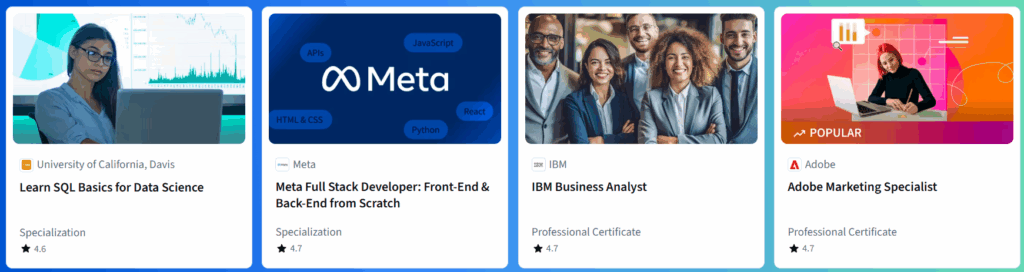
🔹 Specializations
Specializations consist of a series of related courses that go deep into one subject 📈.
They help with:
- Building strong subject understanding
- Learning step-by-step in a structured path
- Showing consistency and discipline
- Developing intermediate to advanced knowledge
Best for:
- Technical fields
- Analytical roles
- People who want depth, not just basics
They signal commitment, which matters in competitive roles.
🔹 Project-Based Certificates
These focus on hands-on, task-based learning 🛠️ rather than theory-heavy lessons.
They involve:
- Real-world scenarios
- Practical problem-solving
- Tool-based work
- Output you can explain in interviews
They are especially helpful for:
- Portfolio building
- Interview discussions
- Demonstrating practical ability
- Gaining confidence in skills
Recruiters often care more about what you can do than what certificate you have and these help with that.
👉 Key takeaway:
The real value is not in collecting certificates, but in choosing the right type based on your career goal and using it smartly with projects, experience, or a portfolio.
💼 Do Employers Actually Accept Coursera Certificates?
Short answer: Yes, many employers do but context matters ✅
Coursera certificates are not seen as a replacement for a college degree, but as proof of skill development and effort 🎯. How much value they hold depends on how and where they are used.
From a recruiter’s point of view, Coursera certificates help answer a few key questions:
- Has this person invested time in learning relevant skills?
- Do they understand tools or concepts used in the job?
- Are they serious about self-improvement?
Here’s how employers typically evaluate Coursera certificates:
- As a supporting credential:
Certificates strengthen your profile when paired with experience, internships, projects, or freelance work. They rarely work alone but add credibility to what you already claim on your resume. - For skill-based roles:
In roles like IT, data, marketing, analytics, and design, employers often care more about what you can do than where you studied. In such cases, Coursera certificates are taken more seriously. - For career switchers and freshers:
If you’re moving into a new field or starting out, certificates help show intent and direction, especially when your degree is unrelated. - During shortlisting and interviews:
Recruiters may not hire you because of a certificate, but it can help you get shortlisted or give you something concrete to talk about in interviews.
Where employers are cautious:
- When certificates are used as a substitute for real experience
- When the learning is too basic for senior roles
- When there’s no practical proof of skills learned
👉 The real value of a Coursera certificate lies in how you apply the learning through projects, real examples, and confident explanations.
In simple words:
Coursera certificates don’t guarantee jobs, but they increase credibility, improve visibility, and help you compete better in skill-driven hiring environments.
Coursera Certificates vs College Degrees
Coursera certificates zero in on immediate, practical skills – like mastering Excel pivot tables or React coding through real projects in weeks.
College degrees emphasize broad knowledge ecosystems, blending math proofs, history electives, and research papers over years, creating well-rounded thinkers but sometimes missing daily job tools. 🎓

Deeper Comparison Table:
| Factor | Coursera Certificates | College Degrees | Winner For… |
|---|---|---|---|
| Skill Focus | Specific (e.g., Google UX Design tools) | General + some electives | Quick job entry 💼 |
| Time to Complete | 1-12 months (5-10 hrs/week) | 4 years full-time | Busy career switchers |
| Total Cost | $200-$1,000 (Coursera Plus) | $40K public / $200K+ private | Budget learners |
| Job Placement | 70% entry-level tech/marketing roles | Leadership, regulated fields | Tech hiring boom |
| Networking | LinkedIn groups, alumni chats | Campus events, lifelong alumni | Traditional networking |
| Longevity | 3-5 years (refresh needed) | Lifetime credential | Senior exec paths |
What US Recruiters Actually Say: At FAANG companies, ATS systems flag Google Data Analytics certs as “hire-ready” – a 2025 Coursera study shows completers earn $60K starting vs. $45K for degree-only applicants without projects. Finance giants like Goldman? Still degree-first for compliance. Hybrid wins: 82% managers prefer candidates with both.
Real Example: Sarah, English major, skipped grad school debt finished IBM Cybersecurity cert (4 months), landed $75K junior analyst at Cisco via LinkedIn. Proves skills > pedigree when portfolios shine.
For freshers, certs bridge “no experience” gaps; pros use them for pivots like marketing to product management. Always match cert to job reqs first! 🚀
When Coursera Certificates Are Actually Useful
Coursera certificates deliver real value when they directly address a job requirement or fill a verifiable skill gap not as generic resume padding. They’re most effective for structured career moves where the role demands that exact knowledge, like transitioning from retail to tech support. 😊
Prime Scenarios Where They Work:
Entry-Level Breaks:
Fresh grads with no experience use Google IT Support Professional Certificate (6 months) to land $55K+ helpdesk roles at companies actively hiring cert holders.
Career Pivots:
A sales rep targets data analysis IBM Data Analyst cert teaches SQL/Tableau via projects, making them interview-ready vs. vague “self-taught” claims.
Skill Upgrades:
Current marketers add HubSpot or Meta certs to manage paid social campaigns, boosting internal promotions or freelance gigs.
Job Board Matches:
Scan postings saying “Google Analytics certified preferred” complete it, apply immediately while skills are fresh. 💼
When They’re NOT Useful:
- Already-proficient pros (e.g., 5-year coder doing basic Python cert).
- Leadership/exec roles needing proven management track records.
- Fields like accounting (CPA trumps) or healthcare (state licenses required).
Maximize Impact Tips:
- Pick certs from job descriptions verbatim – ATS loves keyword matches.
- Build portfolio during course (GitHub repos, case studies).
- Apply within 30 days of completion – momentum matters to recruiters.
- Track ROI: Aim for roles paying 20%+ over current salary.
Real talk: A barista became a $68K UX coordinator via Google UX Design cert + Figma portfolio in 4 months. Certificates open doors when backed by demonstrable work. No projects? Minimal value. 🎯
🏭 Industries Where Coursera Certificates Have Real Value
Coursera certificates show their strongest impact in industries where skills evolve quickly and employers care more about current ability than traditional credentials 🎯.
In these fields, hiring managers often look for proof that you can do the work, not just talk about it.
Technology & IT 💻
This is the most certificate-friendly space. Employers often test skills through interviews, tasks, or assignments. Certificates in areas like IT support, cloud tools, networking, or basic programming help show that you understand modern systems and workflows.
When paired with labs or projects, they can significantly improve shortlisting chances especially for entry-level roles.
Data, Analytics & AI 📊
In data-related roles, certificates are useful because they usually include tool-based learning (spreadsheets, SQL, dashboards, analytics concepts).
Recruiters still expect hands-on ability, but certificates help show you’ve followed a structured learning path and understand core concepts. This is valuable for career switchers and freshers.
Digital Marketing & Business Skills 📈
Marketing, SEO, ads, analytics, and project management are skill-driven fields. Employers often value up-to-date knowledge because tools and strategies change frequently.
Certificates signal that you’re learning current practices, which is important when experience is limited.
Design, UX & Creative Roles 🎨
In creative fields, portfolios matter the most but certificates add context. They show that your work is backed by structured learning and industry frameworks.
This helps especially for beginners who are still building confidence and direction.
Operations, Supply Chain & Support Roles ⚙️
For roles focused on coordination, planning, or process improvement, certificates help professionals understand modern tools and methodologies.
They’re useful for upskilling within the same industry or moving into related roles.
Where certificates matter less:
- Regulated professions that require licenses or degrees
- Senior or leadership roles without experience
- Fields where academic qualifications are mandatory
👉 Bottom line:
Coursera certificates work best in industries that value practical skills, adaptability, and continuous learning. They won’t replace experience but they help you prove readiness and stay competitive.
Free vs Paid Coursera Certificates: Detailed, Honest Breakdown 💸🎓
(What actually helps your career and what doesn’t)
Most people ask the wrong question:
“Free or paid which is better?”
The real question recruiters care about is:
👉 “What did this person actually do with the learning?”
Still, the difference between free and paid does matter just not in the way Coursera ads suggest 😊
Free Coursera Courses (Audit Mode) 🆓
Free courses let you learn, not prove.
What You Really Get
- Access to video lectures
- Reading materials
- Concept understanding
That’s it.
No verified certificate.
No graded proof.
No shareable credential.
How Recruiters See Free Courses 👀
They usually never know you took one because:
- There’s nothing official to show
- You can’t add it as a credential
If you mention it in interviews, it helps only if:
- You clearly explain the skill
- You applied it in real work
Free courses are learning tools, not resume assets.
Best Use Case 💡
- Exploring a new career path
- Strengthening weak basics
- Supporting your current job
Think of free courses as practice rooms, not certificates.
Paid Coursera Certificates 💳📜
Paid certificates are about verification, not just learning.
What You Actually Get
- Identity-verified certificate
- Graded assignments & quizzes
- Sometimes real-world projects
- Shareable link for resume & LinkedIn
This matters because recruiters trust completed, assessed learning more.
How Recruiters See Paid Certificates 💼
A paid certificate from Coursera tells recruiters:
- You committed time and effort
- You followed a structured path
- You met minimum performance standards
Still this is important 👇
Recruiters do not assume expertise just because it’s paid.
They will still ask:
- “Can you explain this concept?”
- “Have you used this skill anywhere?”
The certificate opens conversation it doesn’t close the deal.
Side-by-Side Reality Check ⚖️
| Aspect | Free Course | Paid Certificate |
|---|---|---|
| Resume value | ❌ None | ✅ Limited but real |
| LinkedIn credibility | ❌ | ✅ |
| Recruiter trust | Low | Medium |
| Skill validation | ❌ | ✅ |
| Job guarantee | ❌ | ❌ |
| Best for | Learning | Signaling seriousness |
How to Add Coursera Certificates to Resume & LinkedIn
Adding Coursera certificates correctly makes them ATS-friendly and recruiter-visible treat them like any professional credential under a “Certifications” section. List the exact name, issuing partner (Google/IBM), completion date, and a short skills link. 💼
Resume Steps:
- Create “Education & Certifications” section.
- Format: “Google Data Analytics Professional Certificate, Coursera (IBM), Completed March“.
- Add bullet: “Mastered SQL, Tableau; built 3 dashboards (link to portfolio)”.
- Keep recent ones (2 years); archive older under PDF.
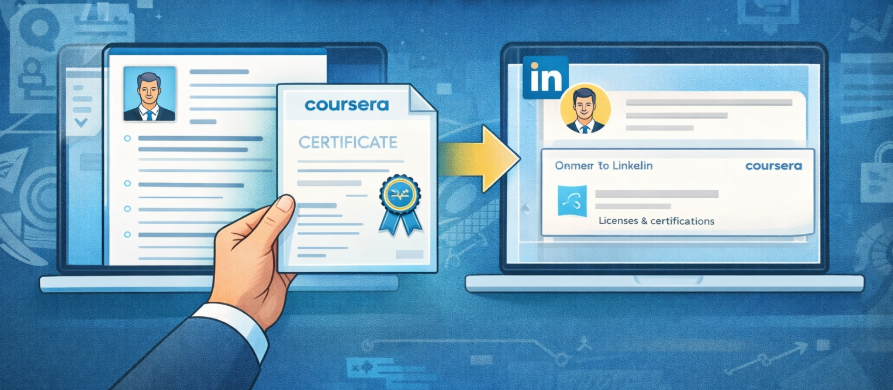
LinkedIn Optimization:
- Go to Profile > Add Profile Section > Licenses & Certifications.
- Paste Credly/Coursera link (auto-verifies).
- Tag skills learned (e.g., “Python, AWS”).
- Add to job descriptions: “Used Google IT cert skills daily as support specialist”.
Pro Tips: Download PDF immediately (links expire). Pin top 3 certs. Message recruiters: “Just earned [cert] – happy to demo projects.” Doubles response rates. Freshers: Lead with certs if degree feels weak. Always link proof! 🎯
🏁 Final Verdict: Are Coursera Certificates Worth It?
So, are Coursera certificates actually worth it?
Yes but only when used the right way ✅
Coursera certificates are not magic job tickets 🎟️, and they are not a replacement for college degrees. But they do hold real value when your goal is to build skills, stay relevant, or support a career move.
Here’s the honest takeaway:
- If you expect a certificate alone to get you hired ❌ → you’ll be disappointed
- If you use it to learn real skills, build confidence, and back your resume ✅ → it’s worth it
Coursera certificates work best when:
- You already have a degree and want to upgrade skills
- You’re switching careers and need proof of preparation
- You’re entering a skill-driven industry
- You combine certificates with projects, practice, or experience
From a recruiter’s mindset:
👉 “This certificate doesn’t hire the candidate but it helps me trust their intent and readiness.”
In simple words:
Coursera certificates are career-support tools, not career shortcuts 🚀.
If you treat them as a way to learn, apply, and grow, they can genuinely strengthen your profile and open more opportunities over time 😊
“RELATED ARTICLES”
- Top Coursera Supply Chain Courses for SCM Professionals
How to Learn Supply Chain & Logistics on Coursera
FAQ ❓
❓ Are Coursera certificates verified and shareable?
Yes. Most Coursera certificates come with a verification link that recruiters can check online, making them easy to share on resumes and LinkedIn.
❓ Do Coursera certificates expire?
No, Coursera certificates do not expire. Once earned, they remain valid, though skills may need updating over time.
❓ Can Coursera certificates help with internships?
Yes. They can help strengthen internship applications, especially for students or beginners who lack practical experience.
❓ Are Coursera certificates useful for freelancing?
Yes. Certificates help build credibility on freelancing platforms when paired with samples or past work, especially in tech and digital roles.

Anas Khan is a digital marketing expert with over 5 years of experience in helping individuals and businesses grow through strategic online learning and coupon codes. He specializes in providing insider tips to maximize savings on learning platforms while guiding professionals toward career advancement. 🚀
With a passion for upskilling and growth, Anas shares valuable insights on how to leverage affordable learning opportunities to enhance skills and stay ahead in a competitive global market. 💡🌍