
Supply chain management has evolved from a back-office operational function into a critical strategic pillar for modern businesses.
Global disruptions, digital transformation, sustainability pressures, and rising customer expectations have reshaped how supply chains are designed and managed.
As a result, supply chain professionals are now expected to understand not only execution, but also analytics, technology, risk, and cross-functional collaboration.
In this context, online supply chain education has gained strong momentum. It allows professionals to continuously upgrade their skills without stepping away from work, while also helping students and early-career analysts build a solid foundation.
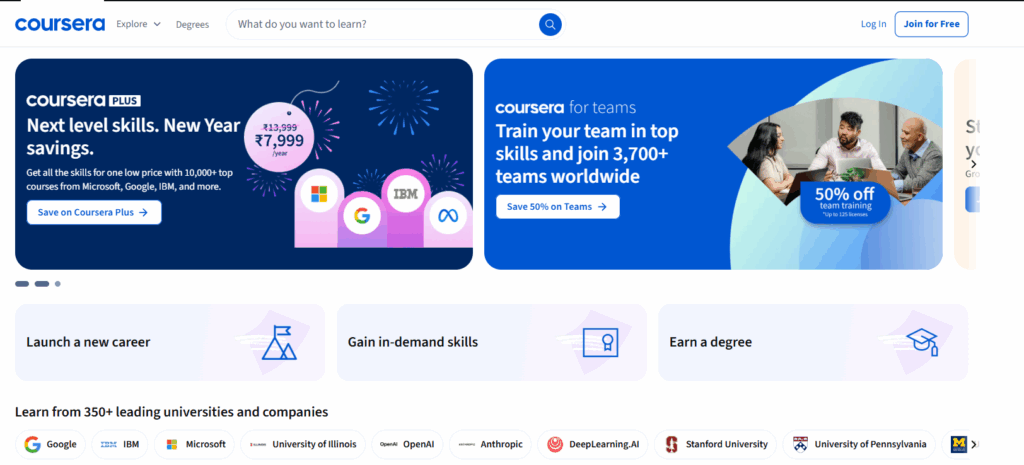
Platforms such as Coursera have played an important role in democratizing access to structured supply chain education from leading institutions.
As we move toward 2026, the real value of these courses lies in how effectively they prepare learners to move from theory to real-world execution in increasingly digital supply chains 🚀.
📌 Why Online Supply Chain Education Is Growing Rapidly
Online learning has become a primary pathway for supply chain professionals seeking flexibility, relevance, and continuous skill development in a fast-changing global environment.
🔹Evolution of Digital Learning in Supply Chain Management 📚
Supply chain education was once largely limited to universities, in-person certifications, and executive training programs. While effective, these formats often required significant time and financial commitments. Digital learning has reshaped this model by offering flexible, modular courses that professionals can complete alongside their jobs. This evolution reflects a broader shift toward continuous, self-paced learning rather than one-time qualifications.
As supply chains become more technology-driven, the content itself has also evolved. Online courses now cover not just traditional logistics and operations, but also analytics, automation, and digital supply chain concepts. This makes digital learning particularly relevant for professionals navigating modern, data-intensive supply chain environments.
🔹Industry Demand for Continuous Skill Development 🔄
Supply chain roles are changing faster than job titles. Professionals are increasingly expected to understand forecasting models, data dashboards, supplier risk, and system-driven decision-making. Skills that were optional a few years ago are now core requirements. Online supply chain courses meet this demand by allowing professionals to update specific skills as industry needs evolve.
Rather than returning to formal education every few years, professionals can now continuously refresh their knowledge. This approach aligns well with industries where disruption is frequent and learning must keep pace with change rather than follow static curricula.
🔹Accessibility of Global Supply Chain Knowledge 🌐
One of the strongest drivers of online education is accessibility. Professionals from different regions, industries, and career stages can access the same high-quality learning resources. This global reach helps standardize supply chain knowledge while also exposing learners to diverse perspectives on logistics, sourcing, and operations.
For students and professionals in emerging markets, this accessibility levels the playing field. It enables participation in global supply chain conversations and prepares learners to work in internationally connected supply networks.
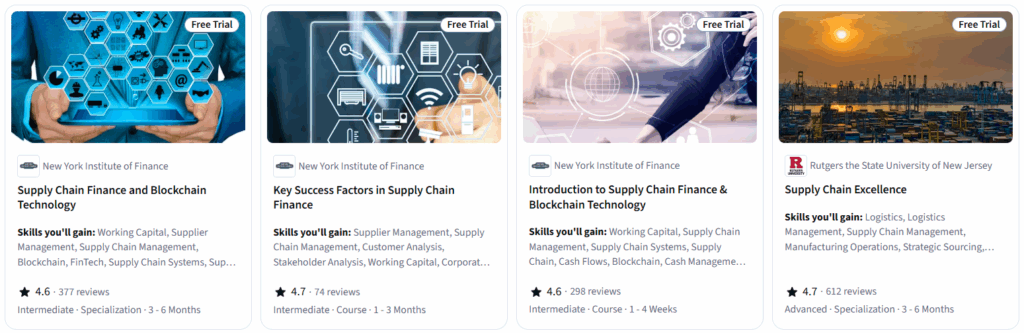
📌 Overview of Coursera’s Supply Chain Course Categories
Supply chain learning is organized into structured categories that allow professionals to progress from fundamentals to specialized and technology-driven topics.
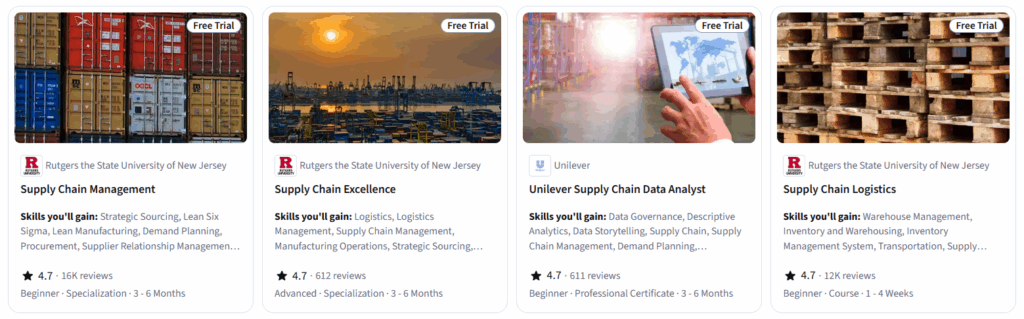
1. Core Supply Chain Management Programs 🏗️
Core supply chain programs typically focus on end-to-end supply chain concepts. These courses cover procurement, production planning, inventory management, transportation, and distribution. They are designed to help learners understand how individual functions connect to form a complete supply chain system.
Such programs are particularly valuable for students, early-career professionals, or managers transitioning into supply chain roles. They establish a shared vocabulary and framework that supports collaboration across teams and organizations.
2. Specialized Courses in Logistics and Planning 🚚
Beyond foundational programs, many courses focus on specific areas such as logistics, warehousing, demand planning, and network design. These specialized courses allow professionals to deepen expertise in particular functions relevant to their roles.
For example, logistics-focused courses may explore transportation modes, route optimization, and warehouse operations. Planning-focused courses often emphasize forecasting, capacity planning, and inventory strategies, helping learners understand trade-offs between cost, service, and risk.
3. Analytics and Technology-Focused SCM Learning 📊
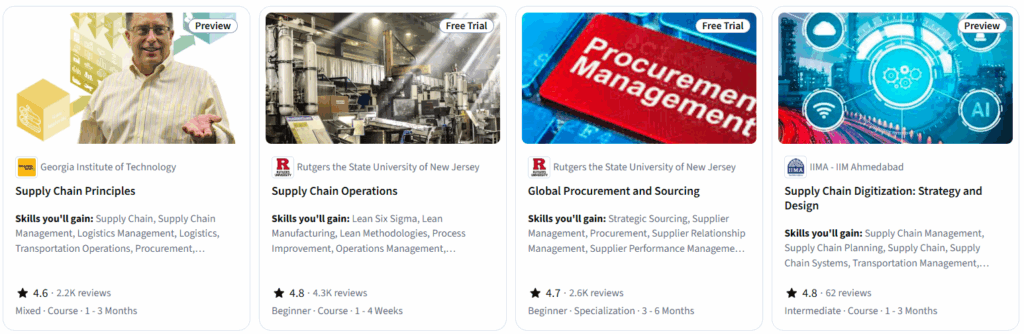
As supply chains become more digital, analytics-focused learning has gained prominence. These courses introduce data analysis, performance measurement, and decision-support models used in modern supply chain management. Learners are exposed to how data informs planning and operational decisions.
Technology-oriented courses also explore topics such as digital supply chains, system integration, and automation. While often conceptual, they help professionals understand how technology reshapes supply chain visibility and responsiveness.
📌 Core Skills Taught in Popular Supply Chain Courses
Online supply chain courses aim to develop a balanced skill set that combines planning, analytical thinking, and operational awareness.
🔹Supply Chain Planning and Coordination 🔗
One of the most critical skills taught in supply chain courses is planning and coordination. Learners are trained to align demand forecasts, inventory policies, and production schedules across the supply chain. This systems-level thinking helps professionals see beyond functional silos.
By understanding how decisions in one area affect the entire chain, professionals are better equipped to manage trade-offs and improve overall performance rather than optimizing isolated functions.
🔹Data Analysis and Decision-Making Skills 🧠
Modern supply chain courses place strong emphasis on analytical thinking. Learners are introduced to forecasting methods, inventory models, and performance metrics that support structured decision-making. These skills reduce reliance on intuition and encourage evidence-based planning.
Even when advanced mathematics is not required, courses focus on interpreting data, understanding variability, and using insights to guide operational and strategic decisions.
🔹Process Optimization and Operational Thinking ⚙️
Another key competency developed through coursework is process optimization. Learners study concepts such as lean operations, bottleneck management, and continuous improvement. These principles help professionals identify inefficiencies and design more resilient workflows.
Operational thinking also includes understanding constraints, lead times, and variability factors that play a major role in real-world supply chain performance.
📌 What These Courses Prepare Professionals For
Online supply chain education prepares professionals for both operational roles and strategic participation within organizations.
1. Entry-Level and Mid-Level SCM Roles 👔
Online supply chain courses are particularly effective in preparing learners for entry-level and mid-level roles. They provide clarity on common responsibilities, terminology, and performance metrics used across organizations. This foundational knowledge helps new professionals integrate more quickly into teams.
For mid-level professionals, courses reinforce best practices and provide frameworks that support more consistent decision-making across functions.
2. Strategic Thinking in Supply Chain Operations ♟️
Beyond operational tasks, supply chain courses help professionals develop strategic thinking. Learners gain insight into how supply chains support business objectives such as cost leadership, service differentiation, and risk mitigation.
This strategic perspective is essential for professionals aspiring to leadership roles, where decisions must balance short-term performance with long-term resilience.
3. Understanding Cross-Functional Supply Chain Teams 🤝
Supply chains operate across procurement, finance, IT, sales, and external partners. Courses emphasize the importance of cross-functional alignment and communication. Learners develop an appreciation for how different teams contribute to supply chain outcomes.
This understanding improves collaboration and reduces friction between departments, a common challenge in complex organizations.
📌 Where Theory Falls Short in Real Supply Chain Operations
Despite strong foundations, theoretical learning cannot fully capture the complexity and unpredictability of live supply chain environments.
🔹Complexity of Real-Time Supply Chain Environments ⏱️
While courses provide structured models, real-world supply chains operate in dynamic, unpredictable environments. Demand fluctuations, supplier disruptions, and transportation delays often occur simultaneously, making decision-making more complex than theoretical examples suggest.
Courses cannot fully replicate the speed and pressure of live operations, where decisions must be made with incomplete information.
🔹Gaps Between Case Studies and Live Operations 📉
Case studies are valuable learning tools, but they are simplified representations of reality. In practice, supply chain professionals must deal with messy data, legacy systems, and organizational constraints that are difficult to model in academic settings.
This gap can create a disconnect between what learners expect and what they encounter in operational roles.
🔹Challenges of Applying Models to Dynamic Markets 🌪️
Many analytical models assume stable conditions, yet modern markets are increasingly volatile. Applying static models to dynamic environments requires judgment, adaptability, and experience skills that develop primarily through practice rather than coursework alone.
📌 The Importance of Practical SCM Platforms After Learning
Applied platforms play a critical role in transforming theoretical knowledge into execution-ready capability.
#Upcoming: Applied Supply Chain Execution Course by ShipChain 🧭
Most online supply chain courses focus on theory, frameworks, and planning models. To complement this learning, ShipChain is developing an upcoming applied course designed to help professionals translate concepts into real operational execution.
The course is expected to focus on practical areas such as demand planning, inventory visibility, order tracking, and cross-functional coordination using a live SCM environment. Rather than static case studies, learners will work with real workflows to understand how supply chain decisions impact cost, service levels, and operational efficiency.
This upcoming course is positioned for professionals who already have foundational supply chain knowledge and are looking to build execution-ready skills through hands-on, platform-based learning.
1️⃣ Hands-On Experience Beyond Certifications 🛠️
Practical SCM platforms provide environments where professionals can apply concepts learned in courses. These platforms allow users to interact with real workflows, data, and constraints, bridging the gap between theory and execution.
Hands-on experience reinforces learning and builds confidence in applying concepts under real-world conditions.
2️⃣ Visibility and Execution in Real Supply Chains 👀
One of the key benefits of applied platforms is visibility. Professionals can see how decisions affect inventory levels, service performance, and costs across the supply chain. This end-to-end perspective is difficult to achieve through coursework alone.
Visibility helps learners understand cause-and-effect relationships that are critical to effective execution.
3️⃣ Learning Through Real Operational Data 📊
Working with real operational data exposes learners to variability, exceptions, and trade-offs that theoretical datasets often exclude. This experience sharpens analytical judgment and prepares professionals for live decision-making.
📌 Bridging Supply Chain Education With Real-World Execution
The transition from learning to execution requires intentional application and continuous practice.
🔹Translating Academic Knowledge Into Practice 🔄
The transition from learning to execution requires deliberate effort. Professionals must actively apply concepts, test assumptions, and reflect on outcomes. This translation process turns abstract knowledge into practical capability.
Without application, even well-designed courses risk remaining purely theoretical.
🔹Role of Digital SCM Platforms in Skill Application 💻
Digital platforms provide structured environments for applying supply chain knowledge. They support planning, execution, and performance tracking, allowing professionals to practice decision-making in realistic contexts.
This practical exposure accelerates skill development and reduces the gap between learning and performance.
🔹Reducing the Learning Curve for Professionals 📉
By combining education with applied tools, organizations can shorten the learning curve for new and transitioning professionals. This integration improves productivity and reduces errors during onboarding and role changes.
📌 How Industry Platforms Support Applied Supply Chain Learning
Industry platforms enable experiential learning by embedding education into real operational workflows.
1. Scenario-Based Learning Through Live Systems 🎯
Industry platforms often support scenario analysis, allowing users to test decisions under different conditions. This form of learning builds intuition and helps professionals understand trade-offs in a controlled environment.
Scenario-based learning complements theoretical education by adding experiential depth.
2. Exposure to End-to-End Supply Chain Workflows 🔁
Applied platforms expose learners to full supply chain workflows, from planning to execution. This holistic view reinforces systems thinking and helps professionals understand interdependencies.
Such exposure is critical for developing leadership-level supply chain insight.
3. Building Job-Ready Supply Chain Capabilities 🧩
Through repeated use, applied platforms help professionals develop job-ready skills. These capabilities extend beyond knowledge to include judgment, adaptability, and operational confidence.
📌 Preparing for Hands-On Supply Chain Experience
Professionals must intentionally move from learning outcomes to measurable operational impact.

🔹Skills Professionals Should Practice After Courses 🧠
After completing courses, professionals should focus on applying planning, analysis, and coordination skills in real settings. Practice solidifies learning and reveals practical nuances that theory may overlook.
🔹Importance of Data, Tracking, and Visibility Tools 🔍
Modern supply chains rely heavily on data and visibility. Familiarity with tracking tools and performance metrics helps professionals connect decisions to outcomes and improve accountability.
🔹Moving From Learning Outcomes to Business Impact 📈
Ultimately, the goal of supply chain education is business impact. Applying knowledge to improve service, reduce cost, or manage risk demonstrates the true value of learning.
📌 The Future of Supply Chain Learning Beyond Online Courses 🔮
The next evolution of supply chain education lies in combining learning with execution in digital environments.
1️⃣ Shift Toward Applied and Platform-Based Education 🚀
The future of supply chain learning lies in combining education with application. Online courses will continue to provide foundational knowledge, but applied platforms will drive skill mastery.
2️⃣ Integration of Learning With Daily SCM Operations 🔗
Learning will increasingly be embedded into daily work through digital tools. Professionals will learn by doing, supported by systems that reinforce best practices.
3️⃣ Continuous Learning in Digital Supply Chains ♾️
As supply chains become more digital and complex, continuous learning will remain essential. The most effective professionals will be those who combine strong theoretical foundations with ongoing, applied experience turning education into execution-ready capability.
📌 Conclusion
As supply chains continue to evolve in complexity, scale, and digital maturity, the way professionals learn must evolve alongside them.
Online supply chain courses provide a strong and accessible foundation helping learners understand core concepts, frameworks, and analytical approaches that underpin modern supply chain management.
They create shared knowledge, structured thinking, and strategic awareness across roles and industries.
However, true supply chain capability is built when this theoretical knowledge is applied in real operational contexts.
The future of supply chain learning lies in combining online education with hands-on, platform-based experience that reflects real data, real constraints, and real decisions.
Professionals who move beyond courses to actively practice, test, and refine their skills will be best positioned to lead resilient, data-driven, and execution-ready supply chains in the years ahead 🚀
FAQs
1. Are Coursera supply chain courses suitable for beginners?
Yes. Many supply chain courses start with foundational concepts such as planning, logistics, and inventory management, making them suitable for students and early-career professionals.
2. Do online supply chain courses prepare professionals for real-world execution?
They build strong theoretical understanding, but real-world execution often requires additional hands-on experience with live data, workflows, and operational constraints.
3. What skills do supply chain professionals gain from these courses?
Learners develop skills in supply chain planning, analytics, coordination, and process optimization, along with a structured understanding of end-to-end supply chain systems.
4. What should professionals do after completing online supply chain courses?
After completing courses, professionals should apply their learning using practical SCM platforms or real operational projects to bridge the gap between theory and execution.
5. How does ShipChain support applied supply chain learning?
Platforms like ShipChain support applied learning by allowing professionals to work with real workflows, data visibility, and execution scenarios that reflect modern supply chain operations.

Anas Khan is a digital marketing expert with over 5 years of experience in helping individuals and businesses grow through strategic online learning and coupon codes. He specializes in providing insider tips to maximize savings on learning platforms while guiding professionals toward career advancement. 🚀
With a passion for upskilling and growth, Anas shares valuable insights on how to leverage affordable learning opportunities to enhance skills and stay ahead in a competitive global market. 💡🌍