
Getting started with supply chain and logistics can feel overwhelming, especially when you don’t know where to begin or which skills actually matter.
This guide walks you through a clear, step-by-step learning path using trusted online courses, helping you turn complex concepts into practical understanding.
If you’re ready to build real supply chain skills and apply them with confidence, let’s get started and explore how to learn it the right way 🚀📦✨
📌 How to Learn Supply Chain & Logistics Step-by-Step on Coursera 🚚📦
If you’re trying to learn supply chain and logistics, the biggest mistake people make is jumping randomly between courses. One course on logistics, another on analytics, another on operations and after weeks of learning, things still don’t connect.
This is why a step-by-step learning approach matters. And this is exactly where Coursera fits well for beginners and professionals.
Step 1: Understand the full supply chain flow first 🧠
Before touching any software or advanced topic, you need clarity on how a supply chain actually works.
At a basic level, a supply chain includes:
- Suppliers
- Manufacturing or sourcing
- Warehouses
- Transportation partners
- End customers
When people skip this step, everything later feels confusing dashboards don’t make sense, reports feel overwhelming, and decisions feel random.
Coursera’s beginner-friendly structure helps learners understand this flow in a logical order instead of fragmented pieces.
Step 2: Learn logistics and transportation as a separate skill 🚛
Logistics is not the entire supply chain it’s a critical part of it.
At this stage, learners focus on:
- How goods move from one location to another
- Why delays happen
- How transportation costs increase
- Where coordination usually breaks
This is important because in real-world supply chains, most operational issues start with logistics failures, not planning mistakes.
Understanding logistics concepts early makes advanced tools and systems much easier to grasp later.
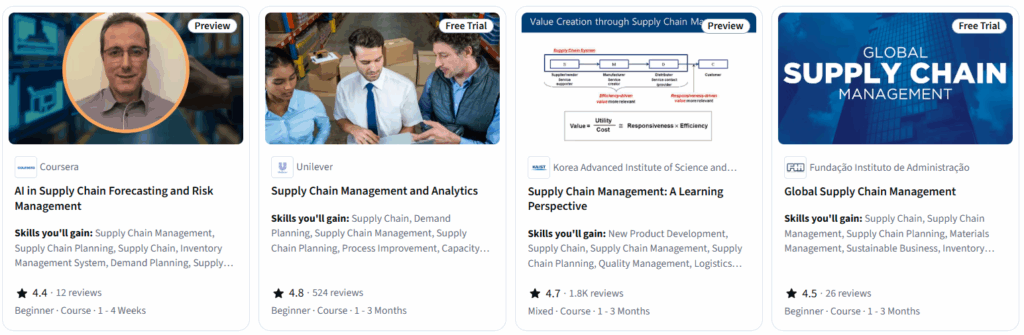
Step 3: Build clear thinking around inventory and warehouses 📦
Inventory management is one of the most misunderstood areas in supply chain.
Many beginners assume:
- “More stock means safety” ❌
- “Less stock means efficiency” ❌
In reality, inventory is about balance:
- Demand vs storage cost
- Availability vs cash flow
- Speed vs accuracy
Coursera courses explain why inventory decisions affect transportation, customer experience, and overall supply chain stability not just warehouse operations.
Step 4: Learn analytics without overcomplicating it 📊
Analytics sounds technical, but at the supply chain level, it’s mostly about better decisions, not coding.
Here, learners understand:
- How demand forecasting works
- How trends are identified
- How delays and inefficiencies are spotted early
You’re not learning analytics to become a data scientist.
You’re learning it to avoid bad operational decisions.
This step usually changes how people look at supply chain data completely.
Step 5: Connect learning with real-world execution 🔗
This is where learning becomes useful.
What you study on Coursera:
- Visibility
- Coordination
- Planning
- Risk management
These concepts exist in real supply chain systems as:
- Shipment tracking
- Shared operational dashboards
- Alerts for delays or exceptions
- Data-backed execution
Once learners reach this point, they stop seeing courses as “theory” and start seeing them as preparation for real operations.
Step 6: Treat supply chain learning as an ongoing process 🔄
Supply chains are never static.
- Routes change
- Demand patterns shift
- Technology keeps evolving
That’s why learning once is never enough. Coursera works well here because it allows professionals to continuously upgrade skills instead of starting from scratch every time.
Honest takeaway ✅
If you are:
- A student entering supply chain roles
- A professional moving into operations
- Someone trying to understand supply chain software
A step-by-step learning path works far better than random courses. Learning first, then applying it in real systems that’s how supply chain knowledge actually sticks.
📌 Supply Chain Fundamentals You Must Understand Before Using SCM Software 🧩
Many people jump into supply chain software expecting instant clarity dashboards, reports, real-time data. Instead, they feel overwhelmed. The issue is not the software. The issue is missing fundamentals.
Before using any SCM platform, you need to understand how supply chains actually behave in the real world. Software only reflects reality; it doesn’t fix weak understanding.
1️⃣ Supply chains are systems, not isolated tasks 🔄
A common misconception is treating procurement, warehousing, and logistics as separate jobs. In reality, supply chains are interconnected systems. A delay at the supplier level doesn’t stay there it impacts inventory, transportation schedules, and customer deliveries.
If you don’t understand this cause-and-effect relationship, SCM dashboards look noisy instead of helpful. This is why foundational learning matters before tool usage.
Courses on platforms like Coursera emphasize system thinking early, helping learners see how one decision ripples across the entire chain.

2️⃣ Flow matters more than speed 🚚
Most beginners focus on speed faster delivery, quicker shipping, instant fulfillment. But experienced supply chain professionals know that flow consistency is more important than raw speed.
Understanding lead times, handoffs between partners, and process dependencies helps you read SCM data correctly. Without this, people misinterpret delays as failures, when they’re often planning or coordination issues.
This foundational clarity prevents wrong decisions later when working with real operational tools.
3️⃣ Inventory is a balancing act, not a number 📦
Inventory levels are often misunderstood as “too much” or “too little.” In practice, inventory is a strategic balance between demand uncertainty, storage costs, and service levels.
If you don’t understand why safety stock exists or how demand variability affects planning, SCM software recommendations feel arbitrary. Fundamentals teach you why inventory behaves the way it does software simply visualizes it.
4️⃣ Visibility doesn’t mean control 👀
Many assume that once data is visible, problems disappear. Visibility helps, but only if you understand what you’re seeing.
Supply chain fundamentals explain the difference between:
- What is delayed
- Why it is delayed
- Whether the delay actually matters
Without this knowledge, users overreact to alerts or ignore critical signals. Foundational learning trains you to interpret visibility correctly before acting on it.
5️⃣ Technology reflects processes, not the other way around ⚙️
SCM tools don’t create good processes—they expose bad ones. If upstream planning is weak, software will show more exceptions. If coordination is broken, dashboards will highlight more conflicts.
This is where understanding fundamentals becomes essential. Platforms like ShipChain are built to support real operational workflows, but they work best when users understand the underlying processes they’re managing.
6️⃣ Why fundamentals save time later ⏱️
Skipping fundamentals may feel faster, but it slows you down later. Teams struggle with adoption, misread data, and make reactive decisions. Those who understand the basics adapt faster, ask better questions, and use SCM tools more effectively.
This is why learning fundamentals first is not optional it’s efficient.
Before diving into Coursera courses or SCM tools, it’s important to understand what supply chain management actually means in a broad, industry-accepted sense, not just from a software or course perspective.
📌 Best Coursera Courses for Supply Chain & Logistics Beginners 🎓🚚
When someone says, “I want to learn supply chain,” the real question is where do I start without getting overwhelmed?
Not every course is meant for beginners, and starting with the wrong one often leads to confusion, not clarity.
This is where Coursera stands out. It doesn’t just offer courses it offers structured entry points into supply chain and logistics, especially for people who are new to the field.
1. If you are completely new to supply chain 🧠
At the beginner level, the goal is not mastery. The goal is orientation. You need to understand the language of supply chain how different parts connect, why delays happen, and how decisions travel across the chain.
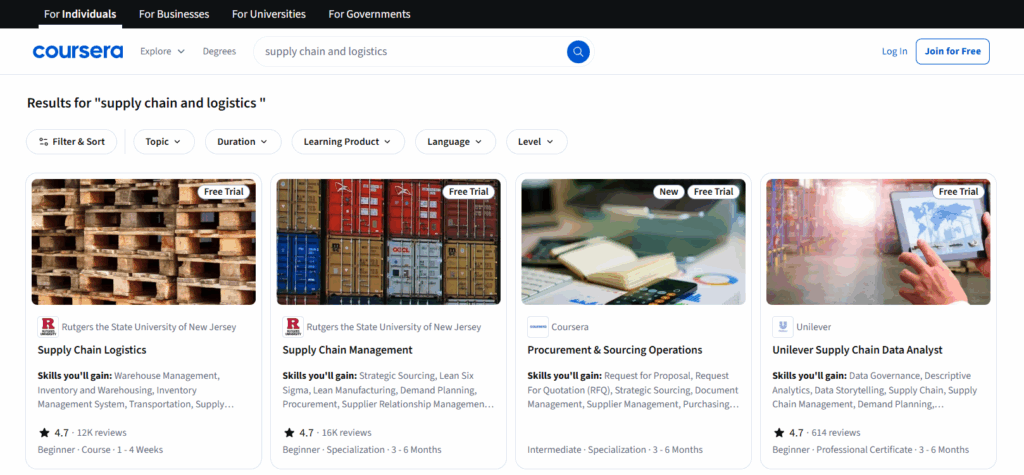
Courses like “Supply Chain Management” by Rutgers University are well-suited here. They focus on explaining the full supply chain flow in simple terms, without assuming prior experience. Instead of jumping into tools or formulas, these courses help learners see the big picture first.
This stage helps remove the fear factor. Once the basics feel familiar, everything else becomes easier to absorb.
2. When you want to understand logistics more deeply 🚛
After fundamentals, most learners naturally become curious about logistics. This is where things start to feel “real,” because logistics is where supply chains usually break.
Courses such as “Supply Chain Logistics” focus on how goods move, why transportation planning is complex, and how coordination failures lead to delays and higher costs. These courses are valuable because they explain problems learners will actually see in real operations not just textbook scenarios.
At this point, learners start connecting theory with real-world situations they’ve heard about or experienced.
3. Learning inventory without making it confusing 📦
Inventory management often feels boring until people realize how much damage poor inventory decisions can cause. Too much stock ties up money. Too little stock breaks customer trust.
Beginner-friendly inventory-focused courses explain these trade-offs clearly. Instead of treating inventory as numbers on a spreadsheet, they show how inventory decisions impact warehouses, transportation, and delivery timelines.
This is usually the stage where learners say, “Now this makes sense.” 💡
4. Getting comfortable with analytics (without panic) 📊
Analytics sounds intimidating, but beginner Coursera courses approach it from a decision-making angle. You’re not expected to become technical you’re expected to become aware.
Courses in supply chain analytics teach learners how forecasts are made, how trends are identified, and why data helps reduce guesswork. The moment learners realize analytics is about better planning, not coding, resistance disappears.
This stage prepares learners for modern supply chain environments where data-driven decisions are the norm.
5. Why these beginner courses actually matter in practice 🔗
Here’s the key insight most people miss:
Courses don’t exist to make you “certified.” They exist to help you function better in real systems.
The concepts learned in beginner Coursera courses directly show up in real SCM platforms things like shipment visibility, planning dashboards, inventory alerts, and performance metrics. When someone later works with tools like ShipChain, the learning suddenly feels relevant instead of abstract.
6. How to choose the right beginner course (simple rule) ✅
If a course:
- Explains why problems happen
- Uses real-world examples
- Doesn’t assume prior experience
Then it’s a good starting point.
Avoid courses that jump straight into advanced models or heavy technical depth at the beginning. Those work better after the foundation is built.
7. Final takeaway 🎯
The best Coursera courses for beginners don’t try to impress you with complexity. They focus on clarity. They help you understand how supply chains behave before asking you to solve problems.
Start simple. Build confidence. Then move forward.
📌 Learning Logistics & Transportation Management Through Coursera
Logistics is often misunderstood as “just shipping.” In reality, it’s one of the most expensive and risk-sensitive parts of the supply chain.
On Coursera, logistics-focused courses help you understand 👇
🔹Transportation Modes & Trade-Offs
You’ll learn:
- Road vs rail vs sea vs air
- Cost, speed, and reliability trade-offs
- When to optimize for time vs money
🔹Network Design Basics
Why warehouses are placed where they are:
- Proximity to customers
- Transportation cost minimization
- Risk diversification
🔹Last-Mile Complexity
Courses now emphasize:
- Urban delivery challenges
- E-commerce fulfillment
- Customer experience impact

👉 Recommended Course:
International Logistics – Georgia Institute of Technology
This course explains why global logistics fails and how smart planning reduces risk.
📌 Inventory Planning & Warehouse Operations: Courses That Actually Matter
Inventory is where cash gets stuck.
Too much inventory = cash flow problems
Too little inventory = lost sales
Coursera courses help you understand this balance.
🔹Inventory Planning Concepts
You’ll learn:
- EOQ (Economic Order Quantity)
- Safety stock calculations
- Service level planning
🔹Warehouse Operations
Key topics include:
- Warehouse layout design
- Picking, packing, and storage strategies
- Labor and automation trade-offs
🔹Demand Variability Handling
Real-world supply chains deal with:
- Seasonal demand
- Promotion-driven spikes
- Supplier delays
👉 Recommended Course:
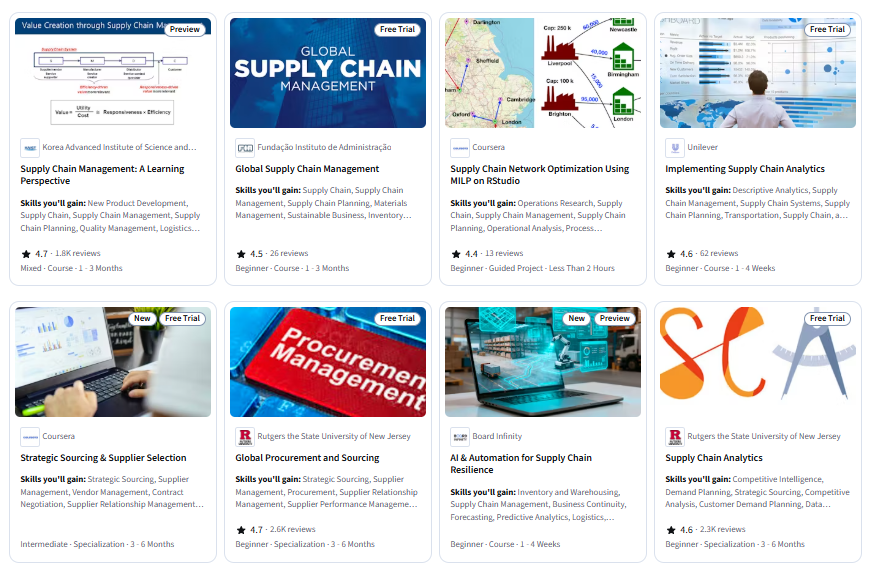
Supply Chain Planning – Rutgers University
This course connects inventory math with business reality, not just formulas.
📌 Supply Chain Analytics & Forecasting Skills Taught on Coursera
Modern supply chains run on data, not intuition.
Coursera analytics courses help you develop:
🔹Forecasting Skills
You’ll learn:
- Time series forecasting
- Demand pattern recognition
- Forecast accuracy measurement
🔹Data-Driven Decision Making
Courses teach:
- Scenario analysis
- What-if modeling
- KPI-based optimization

🔹Translating Data into Action
This is critical:
- Analytics without action is useless
- Decisions must improve cost, speed, or reliability
👉 Recommended Course:
Business Analytics for Decision Making – University of Colorado
This course focuses on using data to decide, not just analyze.
📌 Managing Risk, Disruptions & Global Supply Chains Through Online Learning
The pandemic, geopolitical conflicts, cyberattacks modern supply chains face constant disruption.
Coursera now includes courses focused on resilience, not just efficiency.
🔹Supply Chain Risk Management
You’ll learn:
- Supplier concentration risk
- Geographic risk exposure
- Inventory buffers vs agility
🔹Global Trade Complexity
Courses explain:
- Customs and compliance
- Trade restrictions
- Currency and geopolitical risks
🔹Digital & Cyber Risks
Modern supply chains rely on:
- APIs
- Cloud platforms
- Data sharing
Risk now includes technology failure, not just physical disruption.
👉 Recommended Course:
Global Supply Chain Management – University of Illinois
This course connects global complexity with operational reality.
In real-world supply chains, disruptions are no longer rare events. Large enterprise platforms consistently highlight that companies must plan for uncertainty, supplier failures, and global shocks as part of everyday operations.
📌 Turning Coursera Learning into Real-World Execution with ShipChain SCM
Courses build knowledge but execution happens inside systems.
This is where learning connects with real supply chain platforms like ShipChain.
🔹Why Learning Alone Isn’t Enough
Many learners face this gap:
- Certificates but no confidence
- Knowledge but no execution experience
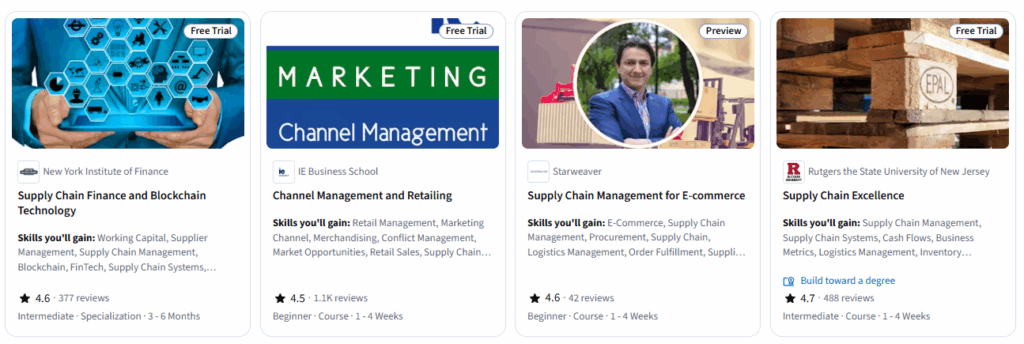
🔹How SCM Platforms Bridge the Gap
When you understand:
- Inventory logic
- Data flows
- Risk management
You can:
- Read dashboards correctly
- Ask better operational questions
- Make smarter planning decisions
🔹Practical Application Examples
Coursera concepts directly support:
- Supplier visibility
- Order tracking
- Performance monitoring
- Risk detection
👉 Key Insight:
Coursera builds thinking ability.
SCM platforms turn thinking into daily operational decisions.
📌 Who Should Follow This Supply Chain Learning Path (Students, Professionals & Teams)
This learning path works for multiple audiences 👇
🔹🎓 Students
Best for:
- Business, logistics, engineering students
- Career switchers entering supply chain
Benefits:
- Industry-aligned knowledge
- Strong resume foundation
- Clear specialization direction
🔹👨💼 Working Professionals
Best for:
- Operations managers
- Procurement professionals
- Logistics coordinators
Benefits:
- Structured upskilling
- Immediate workplace application
- Better cross-team collaboration
🔹🏢 Teams & Organizations
Best for:
- Supply chain teams
- Operations departments
- Digital transformation initiatives
Benefits:
- Shared vocabulary
- Better decision alignment
- Reduced operational silos
📌 Final Takeaway: From Learning Supply Chain on Coursera to Running Real Operations
Learning supply chain & logistics on Coursera is one of the smartest career investments you can make today if you do it correctly.
Here’s the truth 👇
Certificates don’t run supply chains.
Understanding, decision-making, and execution do.
Coursera gives you:
- Structured knowledge
- Global best practices
- Industry-recognized credentials
But real impact comes when you:
- Follow the right learning order
- Focus on applied understanding
- Connect learning with real systems and workflows
If you approach supply chain education as a skill-building journey, not just course completion, you’ll move from learner → contributor → decision-maker much faster.

FAQs
❓ Is Coursera good for learning supply chain and logistics?
Yes. Coursera offers industry-recognized supply chain and logistics courses from top universities. These courses help build strong fundamentals, practical understanding, and job-ready skills when followed in the right order.
❓ Do I need a business or engineering background to learn supply chain?
No. Most beginner-level supply chain courses on Coursera start from basics. Students from any background can learn supply chain concepts with consistent practice and real-world examples.
❓ Are Coursera supply chain certificates useful for jobs?
They can be helpful, especially for entry-level roles or career transitions. Certificates work best when combined with practical knowledge, case studies, and an understanding of real supply chain operations.
❓ How long does it take to learn supply chain and logistics on Coursera?
For basics, 2–3 months is enough with regular learning. To gain deeper skills in analytics, logistics, and risk management, 6–9 months of structured learning is more realistic.

Anas Khan is a digital marketing expert with over 5 years of experience in helping individuals and businesses grow through strategic online learning and coupon codes. He specializes in providing insider tips to maximize savings on learning platforms while guiding professionals toward career advancement. 🚀
With a passion for upskilling and growth, Anas shares valuable insights on how to leverage affordable learning opportunities to enhance skills and stay ahead in a competitive global market. 💡🌍